
September 21, 2026 · 6 min read
How to calculate calories and macros in a homemade recipe
Add up every ingredient, then divide by servings. The method is simple and the mistakes are predictable. A worked example for any home-cooked recipe.
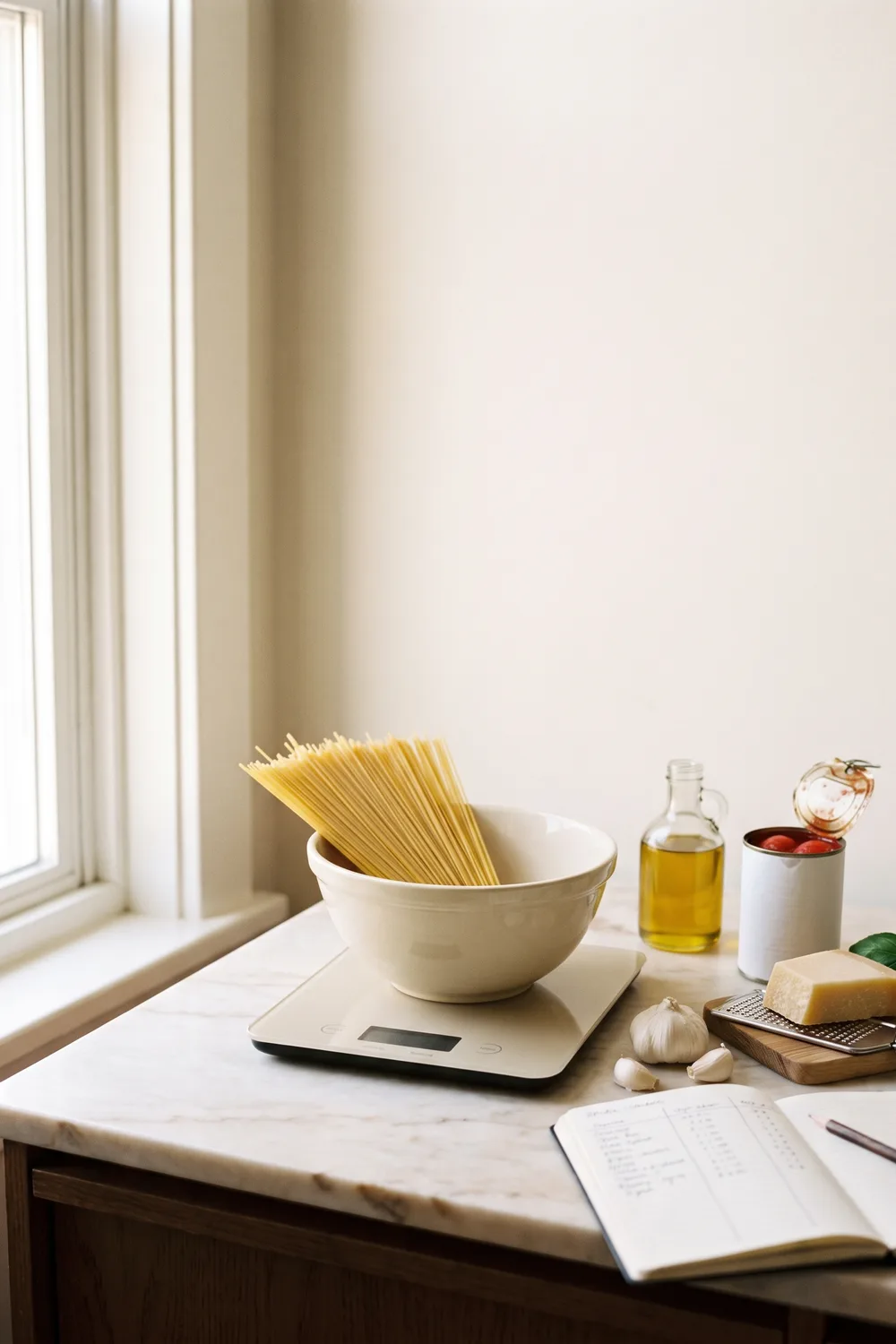

To calculate the nutrition of a homemade recipe, weigh each ingredient, look up its calories and macros per 100 grams in a food composition database, multiply by the amount you used, add everything together, and divide the total by the number of servings. That is the entire method. It is the same approach many food manufacturers use for their labels, and it takes ten to twenty minutes by hand for a typical dinner.
The arithmetic is easy. The accuracy depends on four or five decisions that most people get wrong, and this guide is mostly about those.
What do you need before you start?
A kitchen scale. This matters more than anything else. A "cup" of flour can vary by a quarter depending on how you scoop it, and a "drizzle" of oil can be one tablespoon or three. Grams do not have opinions.
A food composition database. In the United States, USDA FoodData Central is free, public and a source many apps draw on. Most countries publish their own national tables, and they are worth using for local products.
The labels of any packaged ingredients you used. For a specific brand of yogurt, stock or sausage, the label on your packet beats a generic database entry.
A decision about what one serving is. Do this honestly. If the recipe says it serves four and your household finishes it between two people, it serves two.
What are the steps?
1. Write down every ingredient with its weight in grams as you add it. Include the oil in the pan, the butter on the vegetables and the sugar in the sauce. Skip only what is truly negligible: salt, dried spices, a squeeze of lemon.
2. Look up each ingredient per 100 grams. Note the calories, protein, carbohydrate and fat. Make sure the entry matches the state you weighed it in. Dry pasta and cooked pasta are separate entries with very different numbers.
3. Multiply. If you used 250 grams of something with 120 calories per 100 grams, that ingredient contributes 250 divided by 100, times 120, which is 300 calories. Do the same for each macro.
4. Add the columns. You now have totals for the whole pot.
5. Divide by your number of servings. For the most accurate result, weigh the finished dish and divide by weight instead, so that a 350 gram portion of a 1,400 gram pot is exactly one quarter of the totals.
What does that look like for a real recipe?
Take a simple tomato spaghetti for two. All figures are rounded.
Dry spaghetti, 200 grams, at about 370 calories per 100 grams: 740 calories.
Olive oil, two tablespoons, at about 120 calories per tablespoon: 240 calories.
Canned tomatoes, 400 grams, at about 20 calories per 100 grams: 80 calories.
Parmesan, 30 grams, at about 400 calories per 100 grams: 120 calories.
The pot totals about 1,180 calories, or roughly 590 per serving.
Now look at where those calories sit. Two spoonfuls of olive oil account for about a fifth of the dish, which is three times what the entire can of tomatoes contributes. The pasta is nearly two thirds. That is what a single total can never tell you, and it is the reason to calculate by ingredient in the first place. If you wanted a lighter version, you now know that trimming the cheese changes little and the pasta portion changes a lot.
Where do most people go wrong?
Mixing up raw and cooked weights. This is the largest single error. Pasta roughly doubles in weight when cooked and rice roughly triples, because they absorb water, while meat loses around a quarter of its weight as it cooks. The calories do not change, only the weight. Weigh ingredients raw and use raw database entries, or weigh cooked and use cooked entries. Never mix the two.
Forgetting the cooking fat. A tablespoon of oil is about 120 calories, and it is the ingredient most often left out. When you shallow fry, not all of the oil ends up in the food, so counting all of it overestimates slightly. Counting none of it is a much bigger mistake.
Trusting the serving count. "Serves four" is a guess made by whoever wrote the recipe. Weighing the finished dish takes ten seconds and removes the guess.
Expecting precision. Even the numbers on packaged food are allowed a margin. In the United States, labeling rules tolerate calorie values that run up to 20 percent over what is printed. A careful home calculation sits in that same range. Treat the answer as "about 600", not "594".
Alcohol and marinades. Alcohol carries 7 calories per gram and does not fully cook off. With marinades and brines, most of the liquid is discarded, so count only a portion of it.
If you want to sanity check a total, the standard factors are 4 calories per gram of protein, 4 per gram of carbohydrate and 9 per gram of fat. Multiply your macro totals by those and the sum should land close to your calorie total.
Can an app do the calculation for you?
Yes, and for anything you cook more than once it is worth it. Recipe nutrition calculators let you type in ingredients and amounts, and they handle the lookup and the arithmetic. They are only as accurate as the amounts you enter, so the scale still matters.
Plate approaches it from the recipe side. When you save a recipe, whether from a food photo, a link or video, or a scanned paper recipe, it estimates calories and macros for every ingredient per serving and shows them alongside the recipe, so you can see which ingredients carry the dish. If the amounts are not what you actually use, you adjust them and the numbers update. The free tier includes core nutrition details, and Plate Pro shows the full ingredient-level breakdown.
One honest limit: these are estimates built from typical values, exactly as a hand calculation is. They are for understanding what you cook. Plate is not a calorie tracker and sets no daily budgets, and nothing here replaces advice from a doctor or dietitian if you are managing a medical condition.
Common questions
How do I calculate calories in a homemade meal?
Weigh each ingredient in grams, look up its calories per 100 grams in a database such as USDA FoodData Central, multiply by the amount used, and add the results to get the total for the whole dish. Then divide by the number of servings, or by weight if you weighed the finished dish.
Should I weigh food raw or cooked when calculating nutrition?
Either works, as long as the database entry matches. Raw is usually easier and more reliable, because cooked weight changes with cooking time and water absorbed. Pasta and rice gain weight when cooked and meat loses it, but the calories in the pot stay the same.
Does cooking change the calories in food?
Cooking does not meaningfully add or remove calories by itself. It changes the weight of food by adding or removing water, which changes the calories per gram. What does change the total is anything you add, such as oil, butter or sugar, and anything you discard, such as drained fat or leftover marinade.
How accurate are recipe nutrition calculators?
They are estimates. Natural variation between ingredients, differences between brands, and how precisely you measure all introduce error. A careful calculation with weighed ingredients is close enough to compare dishes and portions, and its margin is comparable to the tolerance allowed on packaged food labels.
Your next recipe starts with a photo.
Turn any meal into a beautiful visual recipe. Be among the first to cook with Plate.
From the kitchen
All stories
September 21, 2026 · 6 min read
How to save recipes from TikTok, Instagram and YouTube

September 21, 2026 · 6 min read
How to digitize handwritten family recipes

September 12, 2026 · 5 min read
How to organize every recipe you have ever saved