
August 3, 2026 · 4 min read
How Plate turns a photo of dinner into a recipe you can cook
Point your camera at a finished dish and Plate writes the ingredients, quantities, steps, and timing. Here is what actually happens in the seconds in between.
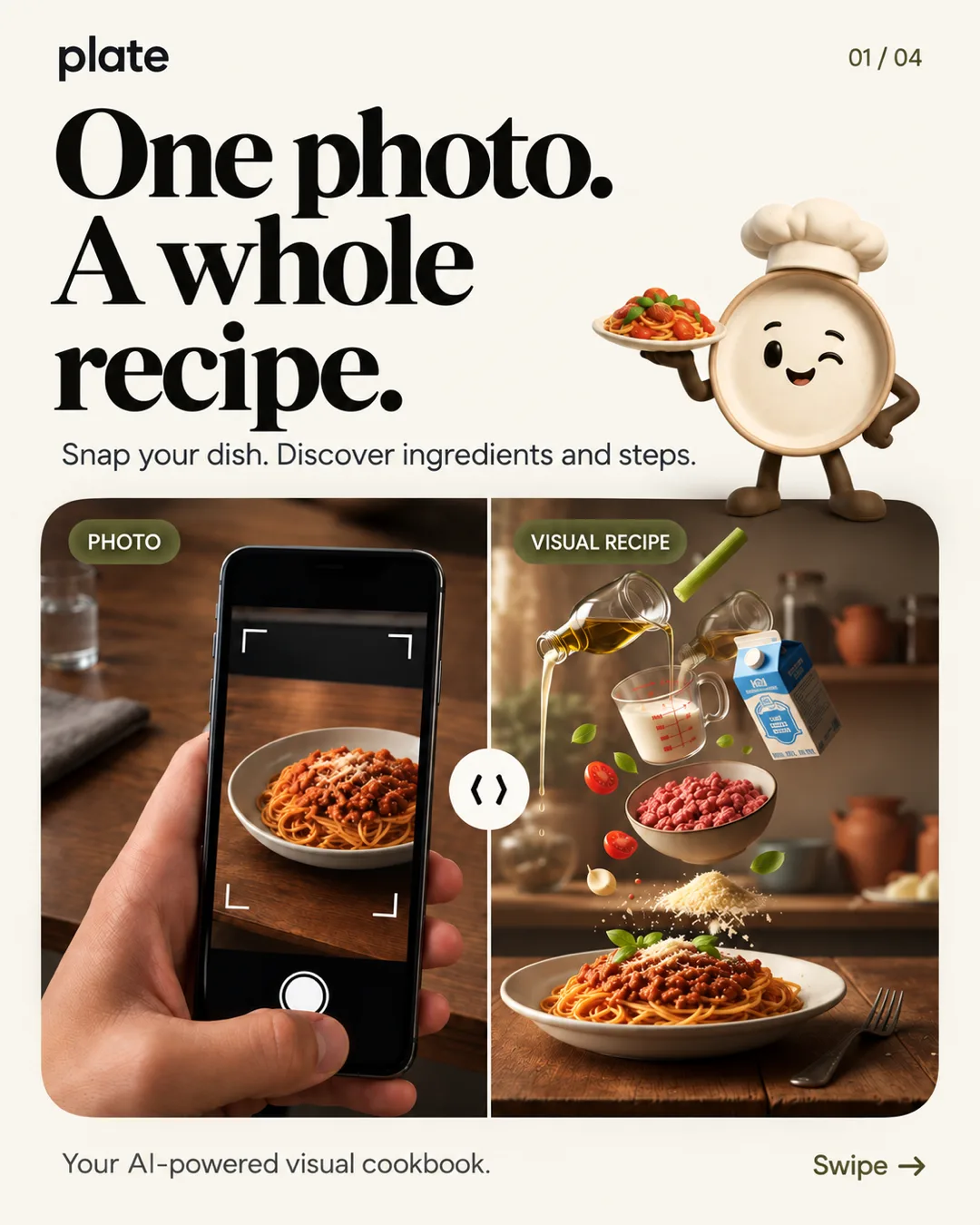
Every recipe in Plate starts with a capture: a photo of the dish in front of you, a link from a chat, or a page from a real cookbook. The photo path feels the most like magic, so it is the one people ask about most. You take one picture of a finished plate — say, spaghetti bolognese — and a few seconds later you are looking at a full recipe with ingredients, quantities, steps, and a nutrition estimate.
No magic is involved, just a carefully ordered pipeline. Here is what happens in those few seconds.
First, Plate names what it sees
The photo is analyzed by a vision model that identifies the dish and works backwards to its likely components: the pasta, the sauce, the ground beef, the parmesan on top. Context matters — the same red sauce reads differently on pasta than it does next to eggs — so the model reasons about the dish as a whole rather than labeling pixels in isolation.
This is also why Plate asks the model for cooking logic, not just labels. A dish is not a list of ingredients; it is a sequence of decisions. Browning before simmering, salting the pasta water, finishing with cheese — these are inferred from how the dish looks and how it is conventionally made.
Then it writes a recipe you can actually follow
The identified ingredients become a structured recipe: quantities scaled to a serving count, steps ordered the way a cook would actually work, and timings attached to each stage. Plate normalizes the result into the same clean format whether the source was a photo, a pasted link, or a hand-typed note — which is what makes the cookbook feel consistent no matter where a recipe came from.
Finally, every ingredient gets a nutrition estimate, and the dish gets its signature visual: the cinematic teardown, with each component floating above the finished plate.
Honest about the edges
AI reading food from a photo is an estimate, not a lab analysis. A hidden ingredient — the anchovy melted into the sauce — can be missed, and quantities are inferred from visual cues. That is why every part of a Plate recipe is editable: fix an amount, add the ingredient only you know is in there, and the recipe, nutrition, and visuals update to match.
The goal is not to replace your judgment. It is to do the tedious 90% — naming, structuring, estimating — so you can spend your attention on the cooking.
Your next recipe starts with a photo.
Turn any meal into a beautiful visual recipe. Be among the first to cook with Plate.